

Detailed Analysis of Business Rates Changes in 2026 Autumn Budget
The 2026 Autumn Budget introduced enhanced Business Rates reliefs and caps on bill increases, but higher multipliers mean some businesses will face rising costs. Read our full breakdown of the changes.
On October 29th the Autumn Budget brought further Business Rates support for retail, hospitality and leisure (RHL) businesses, including increased reliefs, higher Small Business Rates Relief thresholds and a two-year cap on bill increases.
However, while the announcements offer welcome support to qualifying businesses, they do not amount to a general reduction or freeze in Business Rates.
The Government has also confirmed the increased multipliers for 2027/28 and extended the 1p Transitional Relief Supplement. For many ratepayers, particularly larger businesses outside the RHL sector, liabilities will continue to rise.
Our Business Rates team examines the changes, who will benefit, and where businesses may face additional costs.
-
Additional Relief for Pubs and Live Music Venues
From 1 April 2027, Business Rates Relief for eligible pubs, social clubs and live music venues will increase from 15% to 35% for the 2027/28 and 2028/29 financial years.
The additional 20 percentage points of relief will not apply to the largest live music venues, those with a Rateable Value (RV) of £1 million or more. These venues will retain the existing 15% relief.
This provides additional support to much of the licensed hospitality sector, although eligibility and the size of individual liabilities will remain important.
-
Higher Small Business Rates Relief thresholds for RHL Properties
The Government is increasing the Rateable Value thresholds for Small Business Rates Relief (SBRR) for qualifying retail, hospitality and leisure properties from 1 April 2027.
The changes are:
- 100% relief: The qualifying threshold increases from £12,000 RV to £18,000 RV.
- Tapered relief: The upper threshold increases from £15,000 RV to £21,000 RV.
Qualifying properties with a Rateable Value of up to £18,000 will therefore receive 100% relief, with relief tapering to zero at £21,000.
Importantly, these increased thresholds are specific to qualifying RHL properties. They do not extend to all small commercial properties.
Smaller businesses outside the qualifying sectors will remain subject to the existing SBRR thresholds, meaning the additional support will not be available to every small ratepayer.
-
A two-year Business Rates bill freeze, but not for everyone
The Budget also introduces a real-terms Business Rates bill freeze for eligible RHL properties, pubs and live music venues until 31 March 2029.
For 2027/28 and 2028/29, increases in qualifying bills will be capped at Consumer Prices Index (CPI) inflation.
This provides greater certainty for eligible businesses, including higher-value RHL properties that do not qualify for full relief.
However, it is important to understand what the freeze means.
A real-terms freeze is not the same as a freeze in the amount payable. Bills can still increase in line with inflation / CPI.
There are also exclusions, including increases in Rateable Value arising from property improvements and the loss of certain other reliefs after 1 April 2026.
For businesses outside the qualifying RHL sectors, the general increase in multipliers will still apply.
-
The 1p Transitional Relief Supplement is being extended
One of the less prominent, but commercially significant announcements concern the Transitional Relief Supplement.
The Government has confirmed that the 1p supplement will continue for a further two years, extending it to 31 March 2029.
The supplement helps fund the wider package of support for businesses receiving Transitional Relief and other RHL measures.
This matters particularly for properties with Rateable Values of £500,000 or more.
Businesses that had budgeted for the supplement to be removed will now need to revise their forecasts. Its continuation means an additional cost remains in place throughout the current revaluation cycle.
For large non-RHL properties, the combined effect of the increase in higher multipliers and the continuing supplement is particularly significant.
-
Supporting Small Business Relief extended
The Government has also announced a further year of protection for businesses previously receiving Supporting Small Business Relief under the 2023 scheme.
The 2026 Supporting Small Business scheme will be extended to cover those businesses for an additional year until 31st March 2028.
This is intended to protect qualifying smaller businesses from substantial increases in liability following changes to their relief entitlement.
-
Vape Shops and Adult Gaming Centres lose access to certain Reliefs
From 1 April 2027, the Government will remove:
- Small Business Rates Relief eligibility for vape shops.
- Eligibility for the lower Retail, Hospitality and Leisure multipliers for vape shops and adult gaming centres (AGCs).
Adult gaming centres may still qualify for ordinary Small Business Rates Relief under the existing thresholds, where the relevant conditions are met, but will no longer benefit from the enhanced RHL provisions.
Affected occupiers should review their likely liabilities ahead of April 2027, particularly where existing budgets assume continued access to these reliefs.
-
The new Business Rates Multipliers for 2027/28
Despite the additional reliefs announced in the Budget, all five Business Rates multipliers will increase from 1 April 2027.
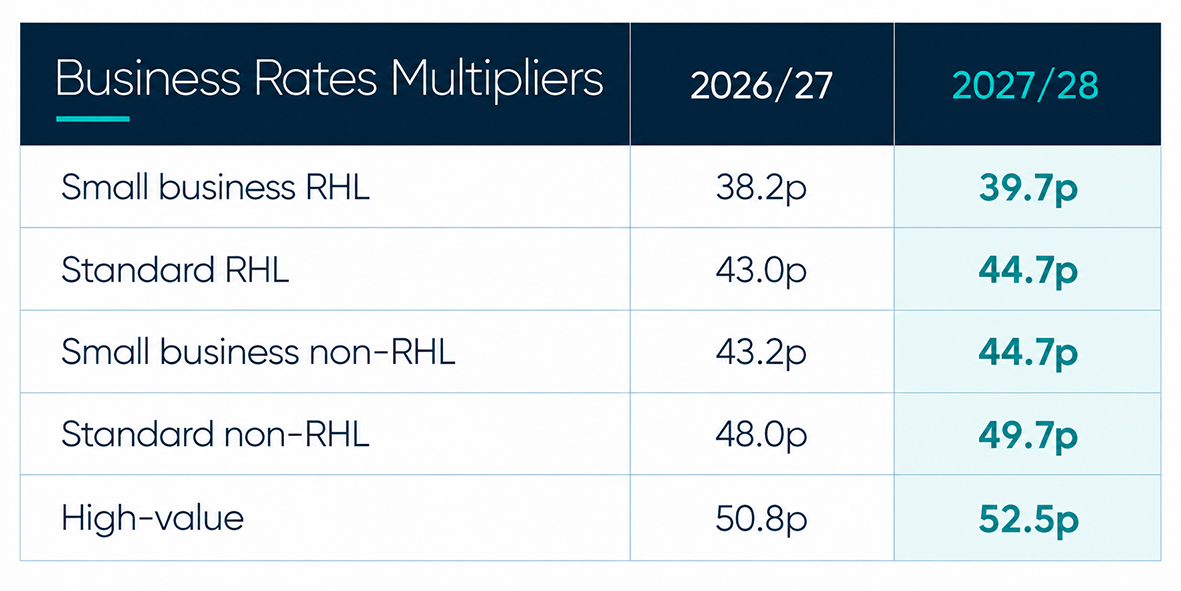
These figures demonstrate why the wider Budget announcements should not be interpreted as a general reduction in Business Rates.
While qualifying RHL businesses may benefit from enhanced relief or limits on bill increases, the underlying multipliers are rising across every category.
For properties that do not qualify for the additional support, the higher multipliers will directly affect their liability, subject to any other applicable reliefs or adjustments.
-
What about larger businesses with Rateable Values above £500,000?
This is perhaps the most important distinction in the Budget from the perspective of larger commercial property owners and occupiers.
The additional support is heavily focused on qualifying RHL properties and smaller businesses.
For large non-RHL properties with Rateable Values of £500,000 or more, there is no equivalent general freeze.
Instead, the high-value multiplier increases from 50.8p to 52.5p in 2027/28, while the 1p Transitional Relief Supplement continues.
This means that, before other applicable adjustments, the combined multiplier and supplement can equate to 53.5% of the property’s Rateable Value.
For example, a non-RHL property with a Rateable Value of £600,000 and not in rates transition, will have a basic annual liability of £315,000 using the 52.5p multiplier, increasing to £321,000 with the 1p supplement, before any other applicable adjustments are made.
From a Business Rates advisory perspective, the absence of equivalent support for larger businesses is a missed opportunity in the Budget measures.
It also reinforces the importance of reviewing the accuracy of Rateable Values, particularly where a property’s RV sits close to a multiplier threshold.
-
Why reviewing Rateable Values around £500,000 matters more than ever
The £500,000 Rateable Value threshold is particularly important because it determines whether a property falls into the high-value multiplier category.
A property assessed at or just above this threshold may therefore face a materially different liability from one assessed below it.
With the high-value multiplier increasing and the Transitional Relief Supplement continuing, there is a particularly strong case to review Rateable Values close to £500,000.
Where a valuation is inaccurate, even a relatively modest correction might reduce the Rateable Value and have the greater effect of altering which multiplier applies. This reduction in RV may produce a significant affect the calculation of the rates bill, leading to a welcome reduction.
This does not mean that every property close to the threshold has successful grounds for an appeal. Any CCA lead process must be investigated carefully before being undertaken to avoid any unintended consequences. A challenge must be supported by appropriate valuation evidence.
Businesses should be confident their assessments accurately reflect their properties, rather than accepting a higher liability without reviewing the valuation.
-
A proposed General Anti-Avoidance Rule
And finally, on the horizon, the Government has announced its intention to introduce a General Anti-Avoidance Rule (GAAR) for Business Rates, following consultation.
The proposed measure is intended to address arrangements designed to avoid Business Rates liabilities.
The detail has yet to be finalised, and it will be important to understand how the legislation distinguishes genuine commercial arrangements from avoidance.
There is already an anti-avoidance framework operating in Wales, raising the question of whether the English approach will follow a similar model.
Property owners and advisers should monitor the consultation and subsequent legislation closely.
-
What should Businesses be doing now?
The Budget provides additional support for certain sectors, but the overall position is more complicated than the headlines might suggest.
Qualifying RHL businesses should establish whether they benefit from the new relief thresholds, enhanced sector reliefs or the two-year cap on bill increases.
Businesses outside those sectors, particularly those occupying larger commercial properties, should review the impact of the higher multipliers and extended Transitional Relief Supplement on their future liabilities.
For all ratepayers, the accuracy of the Rateable Value remains fundamental.
A relief or multiplier can only be applied to the assessment in place. If that assessment is incorrect, the resulting liability will also be incorrect.
At QuoinStone, our Business Rates team works with owners and occupiers to review Rateable Values, identify valuation inaccuracies, assess relief eligibility and challenge liabilities where there are appropriate grounds.
With further changes taking effect from 1 April 2027, now is an appropriate time to understand how the new measures will affect your property and whether your current assessment is correct.
For advice on your Business Rates position, contact QuoinStone Business Rates on info@quoinstone.consulting, or call +44 (0)20 3393 3314.